

From Building to Powering: Energy, Innovation, and AI Infrastructure at a Global Crossroads

On stage, SFLCT Chairman of the Board Fernando C. Hernandez serves as Event Chair at ALJ Group’s American Data Centers Forum in Houston
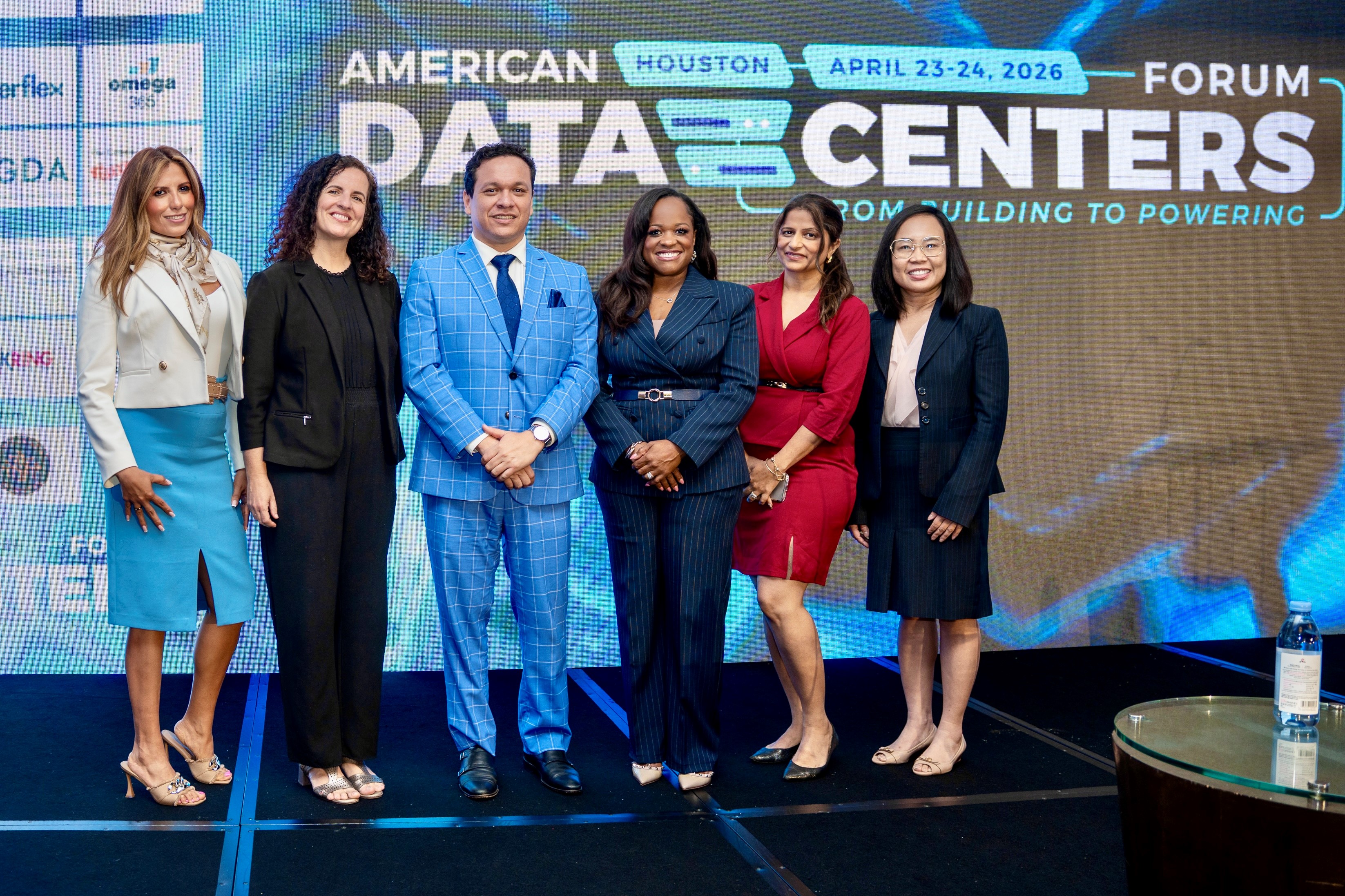
Microsoft keynote speaker Khia Chukudebelu (center right) and SFLCT Chairman (center left), joined by representatives from their respective organizations at ALJ Group’s American Data Centers Forum
HOUSTON, TX, UNITED STATES, October 9, 2026 /EINPresswire.com/ -- At ALJ Group’s “American Data Centers Forum: From Building to Powering,” the Society for Low Carbon Technologies (SFLCT) connected the themes of three consecutive ALJ Group conferences held within one week, spanning Liquefied Natural Gas (LNG), hydrogen and Carbon Capture Utilization Storage (CCUS), and data centers.
This came via SFLCT Chairman of the Board Fernando C. Hernandez who opened proceedings at the data center forum as Event Chair and Master of Ceremonies with “Data Centers and the Strait of Hormuz: The Next Compute Cycle.” Khia Chukudebelu, Partner and General Manager, Datacenter Global Supply Chain at Microsoft, then delivered the keynote, “From Building to Powering: Enabling the Next Era of AI at Scale.” Hernandez, drawing on firsthand experience at the Strait of Hormuz (documented in “illuminem”), examined how the Middle Eastern conflict affects energy systems, carbon management infrastructure, digital networks, and specialized gases and raw materials supporting the global semiconductor supply chain.
He highlighted how reported attacks affecting Ras Laffan’s co-located LNG and Carbon Capture Storage (CCS) infrastructure could recarbonize LNG supplies. This exposes vulnerabilities in the natural gas–CCS model being pursued in the U.S. to power AI data centers with lower-carbon electricity. Reported strikes on regional data centers further illustrate the exposure of digital infrastructure to physical warfare, marking a new dimension of modern conflict. Extending beyond the “next compute cycle,” these developments carry implications for LNG, ammonia, specialized gases, subsea fiber networks, advanced chip manufacturing, and digital sovereignty. This equally applies to wartime AI deployment by a leading large language model company amid the Hormuz conflict.
Bridging Hormuz to Taiwan, TSMC’s Arizona expansion illustrates geographic diversification for advanced chipmaking. SFLCT (via former Government Affairs Director Alissa Nixon) engaged with Congressman Abe Hamadeh (AZ-08), whose district hosts TSMC’s fabrication infrastructure. Because TSMC manufactures chips designed by NVIDIA and other technology leaders, securing global AI compute requires pairing diversified fabrication with resilient energy systems, as highlighted by Hernandez. Just as conflict around Hormuz threatens energy flows, concentrating advanced chipmaking in Asia risks creating a “digital Strait of Hormuz,” a potentially calamitous geopolitical chokepoint for global AI infrastructure.
In her keynote, Chukudebelu framed AI as a transformative technology and outlined Microsoft’s global data center footprint, supported by more than 185,000 miles of optical fiber. She detailed Microsoft’s sustainability commitments, including becoming carbon negative, water positive, and zero waste by 2030, and removing historical emissions dating to 1975 by 2050. Her closing message reinforced “From Building to Powering,” emphasizing that advancing AI infrastructure requires an entire ecosystem moving together.
Both Hernandez and Chukudebelu will return for ALJ Group’s upcoming “American Data Centers Construction Forum,” with Chukudebelu serving as Event Chair and Hernandez moderating the opening plenary. Hernandez concluded by stating that “ALJ Group's conferences generate a radius of impact beyond the events themselves, advancing multi-sectoral collaboration that extends to the upcoming American Data Centers Construction Forum.”
*Publishing note: The views expressed are those of SFLCT, a federally recognized U.S.-based 501(c)(3) nonprofit, and do not necessarily reflect the positions of any organizations or individuals referenced herein. This publication is shared for news-reporting, educational, community-impact, and non-commercial purposes. No endorsement is implied. These purposes align with SFLCT's federal tax-exempt status. Images are reproduced for contextual, analytical, and educational purposes, where permitted under applicable copyright law, including fair use provisions. *
Press Relations
Society for Low Carbon Technologies
Visit us on social media:
LinkedIn
Legal Disclaimer:
EIN Presswire provides this news content "as is" without warranty of any kind. We do not accept any responsibility or liability for the accuracy, content, images, videos, licenses, completeness, legality, or reliability of the information contained in this article. If you have any complaints or copyright issues related to this article, kindly contact the author above.
