

Why Is Competitive ELISA the Only Option for Small‑Molecule Detection?
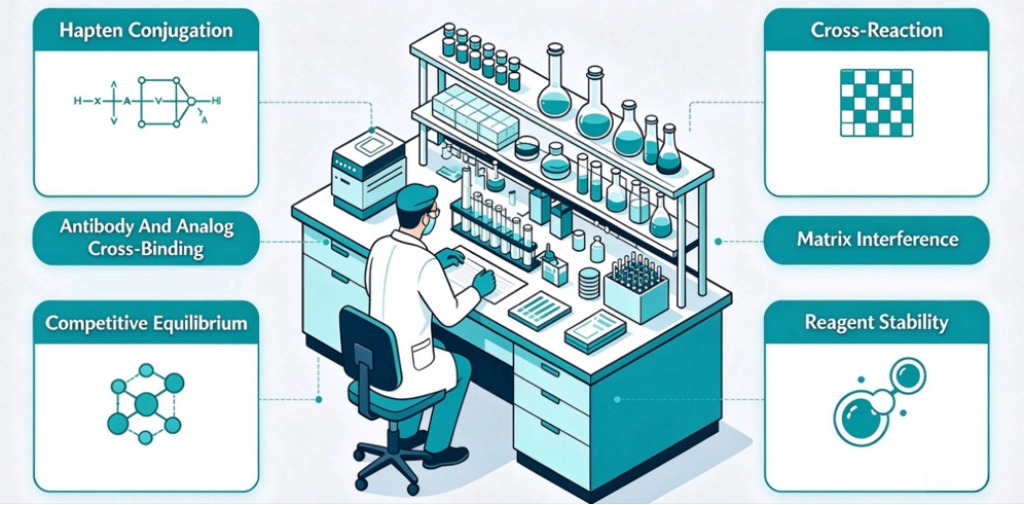
Unpacking Five Key Development Barriers of Competitive ELISA and Cloud‑Clone’s Full‑Link Technical Breakthroughs
HUSTON, TX, UNITED STATES, November 3, 2026 /EINPresswire.com/ -- Small-molecule analytes including steroid hormones, biotoxins and pharmaceutical compounds are key read-outs across endocrinology, pharmacology, toxicology and food-safety research. Unlike large protein biomarkers that can be readily measured with sandwich-type ELISA, small-molecule targets impose unique technical constraints for immunoassays. Many research teams encounter distorted standard curves, poor reproducibility or invalid readouts when attempting inappropriate assay formats. Cloud-Clone has built a dedicated development platform for competitive ELISA kits, addressing the full-chain technical challenges for robust small-molecule quantitation and supporting global scientists with ready-to-use assay solutions.
Core Fundamental Principle: Why Small-Molecule Analytes Are Incompatible with Sandwich ELISA
Sandwich ELISA delivers stable and accurate measurements for macromolecular targets such as cytokines and full-length proteins. Nevertheless, this format cannot be applied to analytes like testosterone, estradiol, cortisol, prostaglandins and drug-derived small molecules. This incompatibility originates from intrinsic structural characteristics of small-molecule substances.
1.Steric hindrance: only one single antigenic epitope Sandwich ELISA strictly requires an antigen to possess two non-overlapping epitopes. One antibody captures the target analyte, while a second detection antibody binds to a separate site, forming a “sandwich-like” complex for colorimetric quantitation. Most small-molecule analytes have molecular weights below 1000 Da and feature extremely compact chemical structures with merely one recognizable epitope. Once the primary antibody binds to the small molecule, the analyte becomes fully enclosed by the antibody Fab fragment. No additional binding site or available spatial position remains for a second antibody. Attempting sandwich assays will result in complete absence of colour development, non-gradient signals and entirely invalid experimental data.
2.Small molecules act as haptens lacking intrinsic immunogenicity Large-size proteins can directly trigger immune responses in host animals to generate specific antibodies. By contrast, isolated small-molecule haptens fail to initiate immune activation. To elicit targeted antibody production, small molecules must first be covalently conjugated to carrier proteins such as BSA or OVA to form composite immunogens. This property further renders them unsuitable for sandwich-based workflows which rely on paired dual antibodies.
3.Competitive ELISA perfectly matches single-epitope characteristics of small molecules Competitive ELISA requires only one specific antibody for target quantitation, operating through competition for a limited pool of antibody-binding sites. Small-molecule-carrier conjugates are pre-coated onto microplate wells. Test samples containing free analyte and a defined quantity of specific detection antibody are then added. Free small-molecule analytes present in samples compete against immobilized coated antigens for available antibody-binding sites.
Higher concentrations of target analyte within samples capture more antibody molecules, leaving fewer antibodies available to bind the solid-phase antigen and producing weaker colour development. Conversely, lower analyte concentrations yield stronger colour signals. Optical-density read-outs show an inverse correlation against analyte concentration. Reliable quantitation can be achieved relying on a single recognition epitope, bypassing structural limitations of small-molecule targets.
Five Major Technical Challenges in Developing Competitive ELISA Kits for Small Molecules
Commercial small-molecule ELISA kits exhibit substantial performance disparities. The whole development workflow faces higher technical barriers compared with macromolecular sandwich ELISA products.
Challenge 1: Difficult-to-control hapten-carrier conjugation directly determines antibody affinity Conjugation represents the initial and most critical step for small-molecule-reagent development. Minor deviations in conjugation sites, conjugation ratios or carrier-protein selection cause two typical adverse outcomes: - Over-conjugation: the small-molecule epitope becomes masked by carrier-protein chains, preventing generation of high-affinity antibodies. - Insufficient conjugation: poor immunogenicity leads to extremely low antibody titres and drastically compromised assay sensitivity.
No universal conjugation workflow fits all analytes. Given divergent functional groups among different small molecules, hundreds of gradient tests for conjugation buffers, reaction temperatures and feed-in ratios are required, greatly extending development timelines.
Challenge 2: Demanding antibody generation and screening; high cross-reactivity risks Many small-molecule compounds including steroid hormones and metabolic toxins differ only by subtle functional-group modifications. Antibodies raised against these targets frequently cross-react with structurally-similar analogues, producing false-positive signals and artificially elevated measured values. Extensive cross-reactivity profiling using homologous analogues must be implemented during development. Hybridoma clones are repeatedly screened to eliminate antibodies recognizing broad conserved chemical frameworks. For analytes below 300 Da molecular weight, obtaining qualified positive antibodies remains a widely-acknowledged industrial bottleneck.
Challenge 3: Hard-to-balance competitive equilibrium: narrow linear range and poor reproducibility Sandwich ELISA benefits from signal-amplification mechanisms, delivering broad linear detection windows and low well-to-well CV values. Competitive assays depend on finely-balanced site-competition dynamics and possess very low reagent-formulation tolerance. - Excess antibody concentration compresses gradients for low-concentration analytes and obscures subtle concentration differences. - Insufficient antibody leads to early saturation at higher analyte levels and truncates the effective detection range.
Extensive iterative optimisation for coated-antigen loading, antibody dilution ratios, tracer concentrations and incubation durations is mandatory to balance assay sensitivity and linear performance. Poor optimisation brings broken calibration gradients and excessive replicate dispersion.
Challenge 4: Severe matrix interference from complex biological samples; cumbersome matrix-neutralisation development Serum, tissue homogenate and urine contain abundant binding proteins, lipids, bilirubin and miscellaneous biomolecules. A large proportion of small-molecule analytes remain bound to endogenous transport proteins and cannot freely participate in competitive binding reactions, generating falsely-suppressed measurement results. Custom sample dissociation-dilution buffers need to be carefully engineered. Inadequate dissociation leaves target analytes unreleased; over-harsh dissociation destroys antibody activity and elevates overall background. Matrix-correction protocols must be individually optimised for distinct sample matrices and species, imposing heavy developmental workload.
Challenge 5: Limited reagent stability; vulnerable substrates and tracers Enzyme-labelled small-molecule tracers used in competitive assays feature fragile chemical structures and readily degrade during long-term storage with loss of binding capacity. Even mild oxidation of TMB substrate causes globally elevated background absorbance. Compared with macromolecular ELISA kits, small-molecule assay reagents demand stricter storage specifications and post-opening shelf-life management. Consistency across production batches is difficult to sustain, which may result in shifted standard curves and variable sensitivity between batches.
Figure 1. Key technical challenges for small-molecule competitive ELISA.
Cloud-Clone Competitive-Format ELISA Kits for Small-Molecule Targets: Resolving Full-Chain Developmental Pain Points
With long-term expertise in immunoassay-reagent development, Cloud-Clone has built a comprehensive small-molecule assay platform that systematically addresses the five above-mentioned technical bottlenecks. The portfolio covers steroid hormones, metabolic small-molecules, biotoxins and drug-residue markers, compatible with research-model samples derived from human, mouse, rat, porcine, rabbit and other species.
1.Customised hapten-conjugation workflow generating high-affinity, target-specific antibodies Tailored conjugation schemes are designed according to functional-group features of each individual small-molecule analyte. Conjugation ratios are precisely adjusted to fully preserve characteristic epitopes. Multiple rounds of animal immunisation and hybridoma screening eliminate clones with high cross-reactivity. Final-release kits achieve minimal cross-reactivity against homologous structural analogues and effectively avoid false-positive interferences.
2.Multi-dimensional gradient system optimisation: broad linear range, low CV and stable reproducibility Hundreds of competitive-formulation gradient validations are completed during product development to fine-tune concentrations for antibodies, coated antigens and tracers, expanding the valid dynamic range of calibration curves. Optimised blocking buffer formulations substantially reduce non-specific adsorption. Well-to-well replicate CV values are maintained at industry-leading levels with minimal plate-to-plate and batch-to-batch deviation. Parallel experimental datasets support publication requirements for SCI-indexed journals.
3.Proprietary sample dissociation-dilution buffers to mitigate matrix interference Specially-pre-optimised pre-treatment dilution buffers are supplied for serum, plasma, tissue homogenate and urine matrices. Bound small-molecule analytes are gently dissociated from transport proteins without compromising antibody bioactivity. Assays tolerate haemolysed, lipaemic and icteric samples. Laborious liquid-liquid-extraction pre-processing steps are not required; limited sample volumes can be loaded directly onto microplates, conserving precious biological material and shortening hands-on processing time.
4.End-to-end quality-control workflow ensuring batch-to-batch consistency and extended reagent usability Stabilisation modifications are applied to small-molecule tracers and coated antigens. Light-protected stable TMB substrate formulations are implemented. Every production batch undergoes full methodological validation including sensitivity testing, linearity verification, spike-recovery assessment and cross-reactivity profiling under unified QC criteria to prevent performance drift across batches. Optimised reagent-aliquoting workflows extend post-opening usable lifetime and reduce consumable waste.
5.Broad analyte coverage plus dedicated one-on-one technical support Ready-to-use kits cover hundreds of widely-studied targets including estradiol, testosterone, progesterone, cortisol, melatonin, prostaglandins, vitamin metabolites, mycotoxins and pharmaceutical small-molecules. Customised assay optimisation can be delivered for rare species, special sample types and ultra-low-abundance analytes. When researchers encounter abnormal curve shapes, high background signals or data-interpretation questions, technical specialists rapidly diagnose root causes originating from matrix effects, operational variables or reagent-related factors and deliver tailored improvement suggestions, minimising trial-and-error cycles and sample consumption.
Competitive immunoassay formats represent the technically-inevitable solution dictated by intrinsic molecular properties for small-molecule quantitation. Competitive-ELISA kit development faces far higher barriers compared with conventional macromolecular sandwich-ELISA products. Many low-cost commercial kits on the market suffer from narrow linear windows, severe cross-reactivity and unsatisfactory reproducibility, which may completely invalidate experiments built upon precious animal-model samples.
Cloud-Clone competitive-format ELISA kits leverage fully-in-house development workflows spanning hapten conjugation, antibody generation, system-level optimisation and matrix-interference mitigation. Balanced performance in sensitivity, specificity and experimental stability supports research workflows across endocrinology-metabolism, pharmacodynamics, toxicology and food-safety disciplines, enabling researchers to generate dependable quantitative small-molecule data efficiently.
Quantitative detection of small-molecule biomarkers remains essential across global biomedical and applied-science research. Cloud-Clone will keep expanding its small-molecule competitive-ELISA product catalogue and continuously refine assay performance, delivering robust immunoassay tools and professional technical assistance for the worldwide research community.
For further information about Cloud-Clone small-molecule competitive-ELISA kits, please visit www.cloud-clone.com.
SuKi Duan
CLOUD-CLONE CORP.WUHAN
email us here
Visit us on social media:
LinkedIn
Instagram
TikTok
X
Legal Disclaimer:
EIN Presswire provides this news content "as is" without warranty of any kind. We do not accept any responsibility or liability for the accuracy, content, images, videos, licenses, completeness, legality, or reliability of the information contained in this article. If you have any complaints or copyright issues related to this article, kindly contact the author above.
